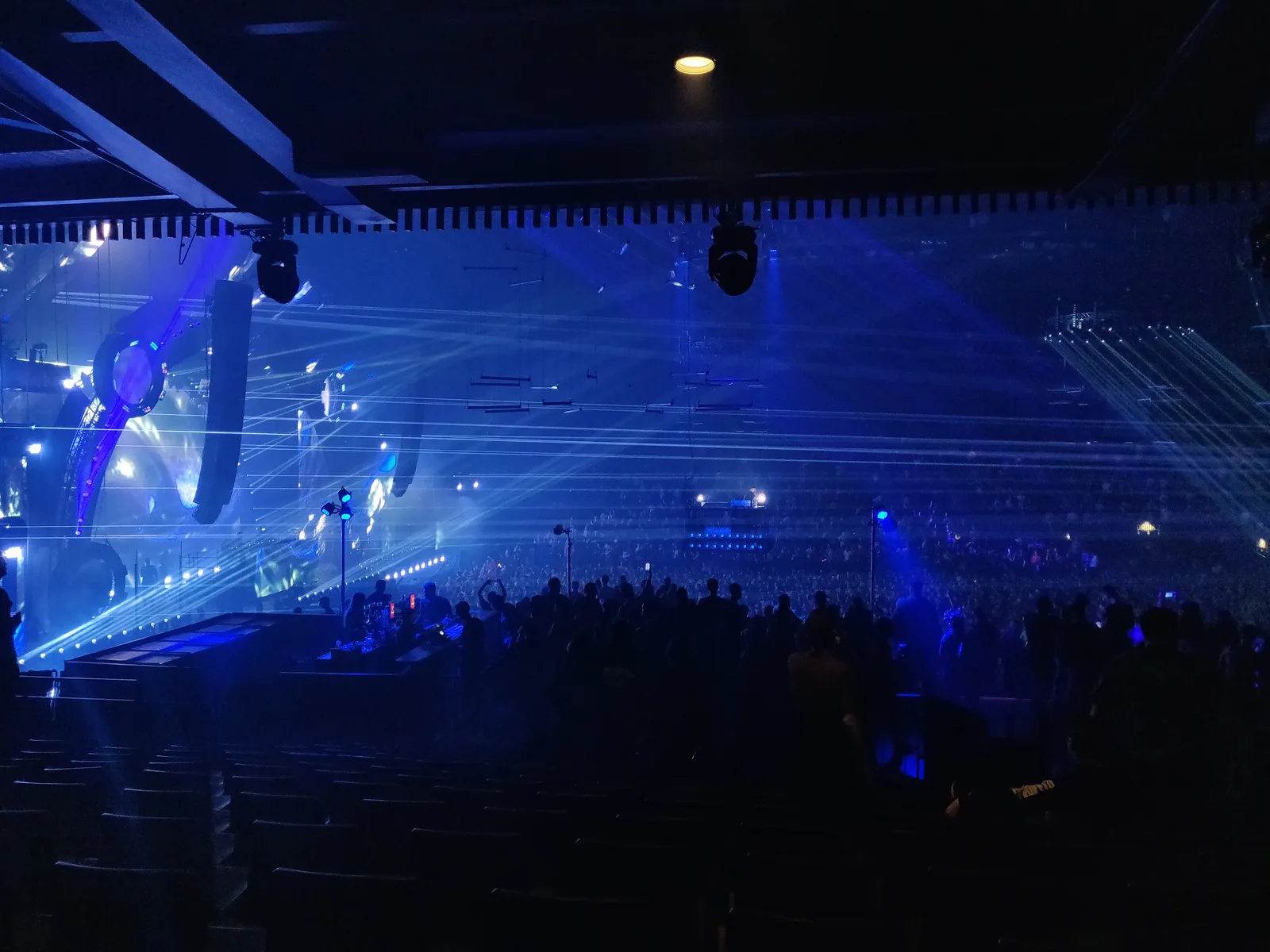
When I first moved to boarding school at the age of 13 is when I started detaching from my family back home in different ways. One of them was my discovery of music. Before then, my taste was largely defined by what my parents listened to. On my mom's side, pop songs and the 80s. On my dad's side, classical music and film scores.
In high school I discovered new genres through the people around me: Green Day from a classmate who was heavily into punk rock, Muse from my art teacher. Both spoke to me in different ways. Green Day had a free, rebellious spirit and stories that light you up. Muse had an experimental sound that felt new, different, at times even hard to appreciate. My mother once 'caught' me listening to Green Day out loud and warned me that this kind of rebellious music could be a bad influence. Muse's sound she didn't appreciate much either. I wished she could understand what I was hearing. There was a structure to it, a buildup and release of energy I couldn't feel in other music.
Then Skrillex dropped his most iconic album and dubstep exploded into internet culture. At first it seemed a bit over the top and ridiculous to me and my friends. I sometimes listened to it as a guilty pleasure, but I largely dismissed it as a meme. Later, when Muse and other bands I liked started getting influenced by dubstep and EDM, I felt like something was trespassing into my domain, and I didn't like it. The people I saw enjoying EDM seemed superficial to me. No lyrics, seemingly no depth or complexity. I just didn't get it yet.
Fast forward to university. Once again I encountered new genres through my peers: techno, R&B, post-rock. At the same time I came into contact with musical elitism for the first time, and it reflected in my own. I refused to listen to rap or pop. Anything trendy, anything made for the masses, turned me off on principle. If it was popular, it couldn't be serious. I had built my taste as much out of what I rejected as out of what I loved.
Then COVID hit and we were stuck indoors for almost two years. Like many people, I got bored and wandered the internet hoping to find something new and stimulating. A close friend, already deep into bass music, started sending me tracks he liked. Virtual Riot, Ray Volpe, Sudden Death, Barely Alive, Tokyo Machine. Some of them artists I would eventually end up working with. To keep track of everything we made a shared Spotify playlist that today counts more than 2000 tracks. We'd both add bass music we wanted to share with each other, and that's how I started dipping my toes into the genre.
But I still kept my distance. I felt some attraction to the unique sound design and the structured, repetitive nature of the music, but it didn't hit yet. Then the lockdowns lifted and Rampage Festival, one of the world's largest bass music festivals, was set to make its return. My friend had been waiting a long time to go and convinced me to come with him. When I told my mother I was going to Rampage she was shocked. The festival takes place near our hometown, so it shows up in the local news, usually for its aggressive sound or the drug use in the crowd. My parents couldn't understand how I had suddenly become interested in something that went so hard. Neither could I, really. This was the same woman who had warned me about Green Day.
I was excited and a little scared. I don't like loud, busy places. I don't dance or openly enjoy music. Music has always been an intimate, personal experience to me. I didn't go to clubs or concerts. Sportpaleis in Antwerp. A giant tiered dome I hadn't set foot in for years. Rampage is known for its production, and the moment we walked into the hall the scale of it hit me: the lights, the rigging, the sheer size of the room. We had VIP tickets, which put us on a raised deck with a clean view of the stage and the floor below. And the floor was a single mass of people, thousands of them, headbanging in unison. I stood there watching them and thought, for the first time in my life, that I would rather be down there than up here. That's how I ended up at the rail, headbanging with strangers.
The timing was probably perfect, after two years of being locked up. There was so much frustration and built-up energy released that weekend. I loved the headbanging, the energy of the crowd, the bass you could feel vibrating in your chest. It doesn't matter if you can't dance. This music is meant to make you go a little stupid. And since then I've been completely captured by the genre. My parents accepted it once they saw how ecstatic I came back.
That doesn't mean I abandoned my earlier love for electronic or experimental rock. I actually found a new appreciation for it. Now I understand why those artists experimented with electronic music when they did, and how that sound shaped their later discography. They're not as different as I thought; the similarities are striking. I never really cared about lyrics anyway. To me the voice is just another instrument. The melody matters more than the meaning. The fact that vocals are largely missing from electronic music was never a downside. It was the point. The thing I had once called shallow turned out to be the thing I had been listening for all along. I had found a type of music that captured not only my mind but also my body. And I yearned for more.